My father handed me a scratched copy of a nineteen seventy three record when I was fourteen and told me to listen to the guitar solo twice. I did, and then I listened to it about forty more times over the next month. That album was older than I was, recorded before I was born, made by men who had already broken up by the time I heard it. It still sounded louder and more alive than anything on the radio that year.
That experience is not unusual. Ask almost anyone who loves this music how they found it, and the story usually involves a parent, an older sibling, or a film soundtrack. Nobody was marketing it to them. They found it and stayed.
So what holds it together? A classic rock artists sound is built from a handful of things that keep working no matter what decade you hear them in. Loud guitars with real bite. Vocals with no safety net. A rhythm section that plays like a band instead of a grid. Songs that say something in three minutes and then stop. And a live show that made people want to stand up.
This piece breaks down each of those elements, explains why they lasted when thousands of other records did not, and looks at what modern artists still borrow from the era without admitting it.
What Core Elements Define the Classic Rock Sound
The core elements are consistent across bands that otherwise had nothing in common. A clean, loud guitar tone with audible distortion. A vocalist singing at the edge of their range. A bass and drum pairing that locks in without sounding mechanical. Lyrics about ordinary struggles, small towns, cars, and escape. And a production style that leaves the instruments sounding like instruments rather than processed effects.
Notice what is missing from that list. There is no single genre. A band from California playing folk influenced rock and a band from Birmingham playing heavy blues both fit the description. The elements are structural rather than stylistic, which is exactly why the sound travels across scenes and continents.
The other shared thread is restraint in arrangement. Most of these records have four or five instruments. Nobody stacked eleven guitar tracks or filled every frequency. What you hear is roughly what you would have heard standing in the room, and that honesty is a large part of why the classic rock artists sound still feels immediate today.
Why the Classic Rock Artists Sound Still Holds Up Today
Nostalgia explains some of it and nowhere near all of it. Plenty of things were popular in nineteen seventy that nobody under thirty listens to now. Survival takes something stronger than sentiment.
Part of the answer is technical. Analog recording captured a natural compression that flatters guitars and drums. Tape softened harsh transients, added harmonic content, and made loud things sound warm instead of painful. Digital recording eventually caught up, and many engineers still simulate that behaviour on purpose.
The bigger reason is emotional. These songs were built for a listener who had one shot at hearing them. Radio played a track once, and if it did not grab you in the first fifteen seconds, you missed it. Composers wrote accordingly. They put the hook early, kept the arrangement lean, and made sure the chorus arrived before anyone could change the station.
That discipline is why the classic rock artists sound translates so well to streaming, film, sports arenas, and video platforms six decades later. A song built to win in thirty seconds wins in any format that requires attention right away.
Guitars, Amps, and the Tone That Defined a Generation
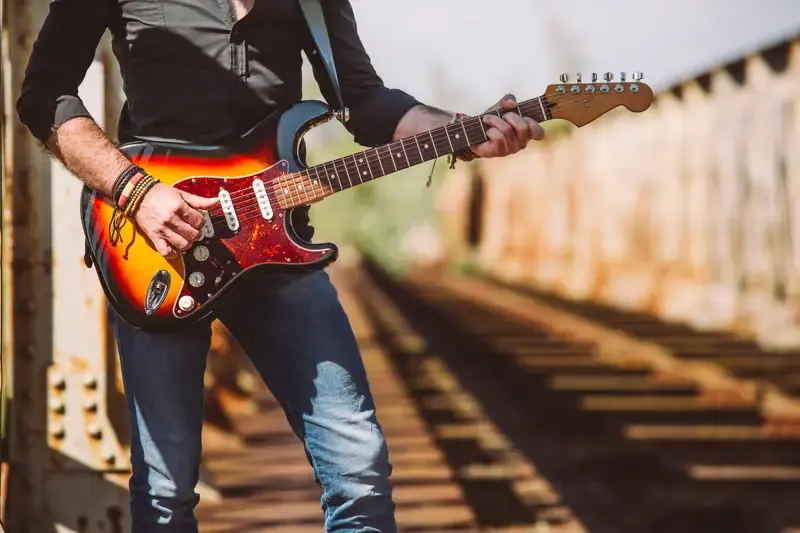
Guitar tone in this era came from equipment pushed past its intended limits. Amplifiers were designed for clean volume, and players turned them up until the tubes distorted. That distortion was not a defect. It became the defining texture of the entire genre.
The difference between a good and a great guitar tone here is mostly in the midrange. Too much treble and the sound slices. Too much bass and it muddies the mix. Bands that lasted found the sweet spot where a single guitar could carry a rhythm part, a lead line, and a vocal bed all at once.
Effects were used sparingly and physically. A wah pedal, a fuzz box, a tape delay. Each one was a single decision rather than a chain of software presets. That limitation forced players to develop touch and dynamics, because the only way to change the sound was to change how they played.
Riffs as the Backbone of the Song
The riff is the most important invention in this music. It is a short repeated musical phrase that functions as the song’s identity. You can hum one without any other part of the track being present, and that is the test.
A good riff does several jobs at once. It introduces the song, gives the guitarist something to build from, and gives the vocalist a platform. When a riff is strong enough, the singer can write almost anything on top of it and the song still works.
Modern producers still study these riffs because they solve a commercial problem. A memorable four bar phrase makes a track recognisable within two seconds, which is precisely what a listener scrolling a playlist needs.
Analog Warmth and Amp Distortion
Tape machines added a gentle saturation that rounded off peaks and made loud recordings feel less fatiguing. Engineers who grew up with that sound noticed its absence immediately when digital arrived, and they spent years trying to recreate it.
Amp distortion works on a similar principle. Valves compress naturally as they are driven, so a hard pick attack does not simply get louder. It gets thicker. That behaviour is why the classic rock artists sound can sit in a mix comfortably even when the guitar is the loudest element by a wide margin.
Vocals That Carried a Room Without Help
Singers in this era performed without pitch correction and without layered harmonies stacked to hide weaknesses. What you hear is one voice, often recorded in a single take, and it either worked or the take was discarded.
That constraint produced a specific kind of delivery. Singers pushed volume, cracked occasionally, and let emotion outrun technical precision. Listeners heard effort, and effort reads as sincerity in a way that flawless technique often does not.
Close your eyes and listen to a rasp in a chorus. It tells you the performer meant it. That quality is one of the most durable parts of the classic rock artists sound, and it is also the hardest thing to replicate artificially.
The Rhythm Section and the Art of Playing Together
Bass and drums in this era played together as a unit rather than tracking separately to a click. Small timing variations created a push and pull that gave the music swing, tension, and release.
Modern recordings are usually built around a grid. Every element snaps to the same tempo map, which makes editing easy and removes the human movement that gave earlier records their pulse. Many current bands deliberately record live and reject that grid for exactly this reason.
The bass deserves particular credit. A good bass line in this music is melodic without showing off. It walks, holds, and lifts the song at the chorus. When people say a record feels big, the bass is usually doing more than the guitar to create that impression.
Songwriting Structure and the Three Minute Format
Classic rock followed a structure so reliable that it feels obvious now. Verse, chorus, verse, chorus, bridge or solo, final chorus, ending. That blueprint appears in thousands of songs because it works.
What separates the good songs from the forgettable ones is what happens inside the structure. The bridge introduces something new. The solo develops the melody rather than just playing scales. The final chorus often shifts key or changes intensity to make repetition feel like a conclusion.
Radio formats drove this discipline. Stations wanted three minute songs, and bands wrote to that requirement. What looked like a constraint turned into an advantage, because brevity forces every part to justify its place in the arrangement.
Live Performance and the Cult of the Concert
The live show was not promotion for the record. In many cases the record was promotion for the show. Tickets, merchandise, and touring income often mattered more than album sales, which changed how bands designed their music.
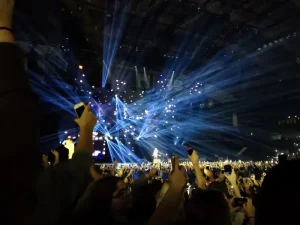
Songs were written with a crowd in mind. A chorus meant to be sung by ten thousand people has different requirements than one meant for headphones. Tempos ran slightly faster. Solos stretched. Intros became call and response moments.
The Live Album as a Career Maker
Live records from this era sometimes outsold studio albums and defined how audiences understood a band. A well captured concert showed what the songs could become when the audience contributed.
Those recordings also documented improvisation that never made it onto a studio release, which gave fans something to compare and argue over. Bootleg culture grew out of the same appetite, and it kept the material circulating long after the original tour had ended.
Stage Presence and Improvisation
No two shows in this era sounded identical. Bands changed arrangements, extended endings, and improvised sections that depended on the room. That unpredictability made attending a show meaningful, because you were hearing something that would not happen again.
Recordings of those variations now circulate online, and they explain part of the enduring popularity. There is always another version to find, which keeps a catalogue alive rather than closed.
Production Choices That Aged Well
The best records from this period used fewer microphones, fewer processing steps, and less time in the editing room. Engineers committed to decisions early because tape was expensive and space was limited.
That economy produced mixes that still hold up on modern systems. Nothing is overcorrected, nothing is compressed into a flat wall, and the dynamic range survives. You can hear a quiet passage get quieter, which means the loud parts feel genuinely loud.
Less flattering production choices from the era have aged badly. Overly bright cymbals, wide stereo effects, and narrow low end all date a recording quickly. The records that survived avoided those extremes.
Why the Classic Rock Artists Sound Crosses Generations
Streaming changed how this music reaches listeners. A song can now appear in a film trailer, a video game, or a short clip and find an audience that never touched a record store.
Sports arenas did enormous work here. Few things spread a rock anthem faster than thirty thousand people hearing it at a stadium every weekend for a decade. That exposure built familiarity without nostalgia, because the audience was hearing it fresh.
The deeper reason is that the music solves a problem young listeners still have. It offers a feeling of size, seriousness, and rebellion without requiring any context to appreciate. You do not need to know the history to feel the impact, and that accessibility is what keeps the classic rock artists sound in circulation.
What Modern Artists Still Borrow From Classic Rock
Modern acts borrow constantly, often without realising the source. Live tracking in one room, analogue saturation plugins, valve amplifiers, and riffs built from blues scales all come from this era.
Some borrow outright. Guitar bands still chase the same midrange tone, and producers still place a room microphone to capture everything at once. Others borrow structurally, using a strong opening riff and an early chorus to win attention in the first fifteen seconds.
The borrowing runs the other way too. Classic rock bands took heavily from blues, folk, country, and rhythm and blues without apology. The style was always a blend, which is part of why it adapted so well to new formats and new decades.
Common Misconceptions About Classic Rock
The first misconception is that the era produced only one type of music. In reality the period contained folk rock, hard rock, progressive rock, southern rock, and pop rock, all sharing the same structural instincts.
The second is that the music was simpler than modern work. Simplicity of arrangement is not simplicity of craft. Getting four musicians to lock in live, with no editing, is harder than assembling forty tracks in software.
The third is that it survives purely on nostalgia. If that were true, the audience would keep ageing and the genre would shrink. Instead it keeps finding new listeners, and that pattern says more about the songs than about memory.
Conclusion
The core elements are straightforward. A loud guitar with real midrange bite. A vocalist who means it. A rhythm section that plays together instead of to a grid. Lyrics about ordinary life. A three minute structure that earns every section. And a live show built for a crowd rather than a playlist.
Those elements explain why the classic rock artists sound has outlasted nearly every trend that arrived after it. It was recorded honestly, performed live, and written to win in half a minute. None of that depends on technology that goes out of date.
If you want to understand why this music lasted, play a record loud on a decent system with the lights off. It will explain itself faster than any article could. The riffs do the work, and they still do it as well as they did the first time.
FAQs
1. What defines the classic rock artists sound the most?
Loud midrange guitars, raw vocals recorded without pitch correction, a live rhythm section, and short three minute song structures. Those elements appear across folk rock, hard rock, and progressive rock alike.
2. Why does classic rock still sound good decades later?
Analog recording softened harsh peaks and added natural warmth, while lean arrangements left room to breathe. Songs were also written to win attention quickly, which suits modern streaming and film use perfectly.
3. Was classic rock really simpler than modern music?
It was simpler in arrangement, not in craft. Four musicians locking together live with no editing is difficult. Modern productions use far more tracks, and many of them still lack the same energy.
4. What makes a great classic rock riff?
A riff works when it identifies the song instantly and can be hummed alone without other instruments. It gives the guitarist a foundation, the singer a platform, and the listener something memorable within a couple of seconds.
5. Why did live albums matter so much to these bands?
Live records often outsold studio releases and showed what songs became with an audience. They also captured improvisation that never appeared elsewhere, which kept the catalogue alive and gave fans new versions to collect.